PUBLICATION QA · RUBRIC V2.0
Two gates,
one verdict.
No article, landing page or station page is approved on judgment alone. Every piece passes through the same two-gate audit and comes out with one grade, one list of defects, and a yes or no. Here is the mechanism.
THE MECHANISM
Facts are checked before quality is judged.
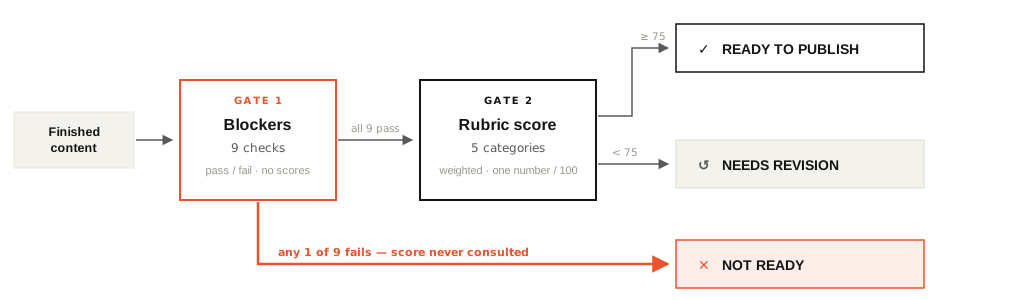
The two gates ask different kinds of question. Gate 1 asks nine questions with factual answers — is there one H1, do the schema and the visible text match, is the pricing sourced. Gate 2 asks how good this is, and answers with a number. Facts come first, because a beautifully written page with invented statistics is not a near-miss. It is a liability.
GATE 1 · BINARY
Nine checks with no room to negotiate.
These are facts, not opinions, so they are recorded as pass or fail with the exact location of the defect and what fixing it requires. Nothing here is scored, weighted, or traded off against anything else.
- 01 / Factual accuracy
No invented statistics, regulations or pricing. Unknowns are flagged, never guessed.
- 02 / Terminology
The market's primary terms, consistently applied, in the correct regional English.
- 03 / Heading structure
One H1, a logical H2/H3 hierarchy, no skipped levels, descriptive headings.
- 04 / FAQ compliance
A descriptive section heading, three to five questions, a bold standalone first answer.
- 05 / Schema parity
Structured data and visible copy match exactly. No schema-only wording.
- 06 / Link format
Internal links in the required form, real post IDs, no “click here” anchors.
- 07 / Search intent match
The page answers the query it targets. Wrong-intent content cannot be graded into readiness.
- 08 / Technical compliance
Alt text present, indexability and canonical concerns flagged, structure CMS-ready.
- 09 / Brand compliance
No sales-heavy language, no corporate jargon, no claims that misrepresent the offer.
GATE 2 · WEIGHTED
Five categories, one hundred points.
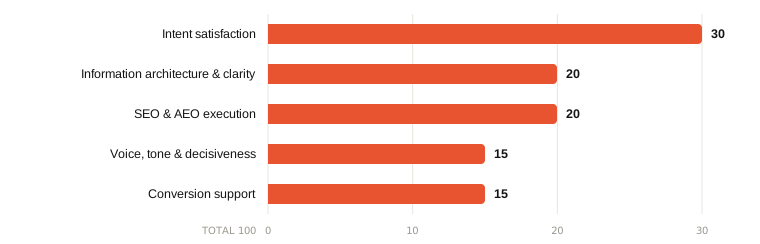
Content that clears Gate 1 is scored on five categories at fixed weights. The weighting is the editorial position made explicit: whether the page answers the reader’s actual question is worth twice as much as how it sounds.
Best-in-class. Publish and use as a reference example.
Strong. Publish.
Solid. Publish, with the high-impact notes applied where cheap.
Publishable floor. Worth a revision pass first.
Does not go live. Back to the writer with cited sections.
The weights shift with the dominant content type before scoring, and the audit states what it moved. Pages close to conversion are weighted for local relevance, booking information and commercial clarity. Informational pages are weighted for depth and answer-readiness. Inspiration-led travel content gets an explicit exception: it is not penalised for being less machine-extractable when the reader experience is stronger for it — destination writing does not become an operations manual to please a snippet.
THE OUTPUT
Every audit returns the same eight things.
The format is fixed, which is what makes results comparable across writers, content types and months.
Detected, with any weight adjustment named.
Ready, or Not Ready.
One letter, one number out of 100.
What, where exactly, and what fixing it takes.
All five, at their weights.
What the piece does well, so it gets repeated.
High, medium and polish — each cited to a section.
Publish or revise, with the reasoning.
DELIBERATE LIMITS
What the gate does not do.
- It does not rewrite. The audit reports; a human or a writing step fixes. Mixing the two would mean the reviewer grading its own work.
- It does not invent standards. The rubric lives in one shared source. If that source cannot be loaded, the audit stops and says so rather than improvising criteria that look authoritative.
- It does not give generic feedback. A note that could apply to any article is not a finding. Every recommendation names its section and its impact.
- It does not publish. The gate produces a verdict. Going live stays a human decision.
- It does not smooth over disagreement. The same rubric runs mid-draft and at the gate. When the two grades differ materially, that gap is reported as signal, not averaged away.
Scope and limits
What this describes: the audit mechanism and rubric structure I designed and operate. Weights, blockers, grade bands and output format are shown; the scoring guidance behind each category is not published.
Limits: the rubric grades a draft against a defined standard. It does not measure published performance — that is what the case-study evidence is for. Rubric v2.0, described as operated in August 2026.